
Section 32 Victoria. What it covers and what it leaves out
For buyers who plan to build, extend, or develop after purchase, the Section 32 vendor statement has significant blind spots that neither the document nor your conveyancer will flag.
Sep 18, 2025 | Rhys Davies


Table of contents
- What a Section 32 is
- What the Section 32 covers
- Where the Section 32 stops
- How long a Section 32 is valid
- What fills the gap
- What a pre-purchase planning assessment covers
If you are buying property in Victoria, you will receive a Section 32 vendor statement before you sign the contract of sale. Most buyers are told to read it carefully and hand it to their conveyancer. That is good advice. But there is a category of information about a property’s development potential that the Section 32 does not cover at all, and conveyancers are not trained to spot it either.
For buyers who plan to build, extend, add a granny flat, or develop in any way after purchase, that gap can be expensive.
What a Section 32 is
The Section 32 takes its name from Section 32 of the Sale of Land Act 1962. Victoria requires every vendor to provide one to a prospective buyer before they sign a contract of sale. It is a disclosure document: the vendor is legally obligated to tell you certain things about the property before the sale goes through.
The document is prepared by the vendor’s solicitor or conveyancer and is handed over at or before the point of contract. In practice, buyers often see it for the first time at auction or just before signing, which does not leave much time for a thorough read.
What the Section 32 covers
| Item | What it tells you |
|---|---|
| Title information | Certificate of Title confirming ownership, lot and plan number, registered encumbrances including mortgages, caveats, and easements |
| Registered covenants and restrictions | Restrictive covenants on the title limiting use or development, reproduced as document text |
| Section 173 agreements | Agreements between previous owners and council that run with the land and bind future owners |
| Planning certificate (Form 10) | The property’s zoning under the planning scheme |
| Outgoings | Council rates, water rates, owners corporation fees if applicable |
| Building permits | Permits issued in the last seven years |
| Services | Confirmation of connected water, sewage, gas, and electricity |
For a buyer whose only concern is settlement going smoothly, a thorough Section 32 review covers most of what matters. But for a buyer who is purchasing with building ambitions, the document has significant blind spots.
Where the Section 32 stops
The Section 32 was designed as a legal disclosure tool, not a development feasibility assessment. The information it contains is accurate as far as it goes, but what it does not tell you is at least as important as what it does.
Planning overlays do not appear. This is the most consequential gap for buyers who want to build. Victoria’s planning scheme applies overlays to properties that trigger additional requirements or restrictions: Heritage Overlays, Design and Development Overlays, Significant Landscape Overlays, Flood Overlays, Bushfire Management Overlays, and others. These overlays can dramatically affect what you are allowed to build, how high, what materials, what setbacks apply, and whether a planning permit is required at all. The Form 10 planning certificate included in the Section 32 states the zoning. It does not list the overlays.
What the zoning permits is not explained. Knowing you are in a General Residential Zone tells you the zone name. It does not tell you the specific requirements that apply: site coverage limits, garden area minimums, setback rules under ResCode, or permitted uses. Each zone has its own schedule of requirements, and councils can have local variations. Your conveyancer knows property law, not planning law.
Unregistered covenants are not covered. Not every covenant makes it onto the title. Some older covenants, particularly those from mid-twentieth century subdivisions, exist in title documents or deposited plans rather than as registered encumbrances. These can still be legally binding and can still restrict what you build, but they will not show up in a standard title search.
Section 173 agreements are listed but not interpreted. If a Section 173 agreement appears in the Section 32, you will see the document. What you will probably not get from your conveyancer is a clear explanation of what that agreement means for any building or subdivision you are planning. Some are innocuous. Others effectively prevent subdivision permanently, restrict the number of dwellings on the lot, or impose specific design requirements.
No assessment of what you can build. The Section 32 tells you what the property is. It says nothing about what you can do with it. Whether a granny flat is feasible, whether a second storey needs a planning permit, whether a dual occupancy would be approved, whether the lot dimensions support subdivision: none of that is in the document.
| Gap | Why it matters |
|---|---|
| Planning overlays | Can require permits, restrict height, limit materials, and reduce site coverage beyond the base zone |
| Overlay implications for your project | A Heritage Overlay and a Flood Overlay have very different consequences depending on what you plan to build |
| Unregistered covenants | May still be enforceable but do not appear in the title search |
| Section 173 agreement interpretation | Listed but not explained in terms of what it means for your building plans |
| Development feasibility | No assessment of what the site will permit or whether your intended project is approvable |
How long a Section 32 is valid
A Section 32 in Victoria is valid for three months from the date it is prepared. If a property sits on the market for longer than that, the vendor needs to update it. This is most relevant for buyers of properties that have been listed for a while. It is worth checking the date on the planning certificate and confirming the title search attached is recent.
What fills the gap
The information missing from a Section 32 is not hidden. VicPlan, Victoria’s online planning map, shows zoning and overlays for any property. The relevant council’s planning scheme is publicly accessible. Title searches can be ordered directly.
The problem is not access to the information. It is knowing what it means for your specific situation. An overlay that is irrelevant for one project can be a deal-stopper for another. A zoning that looks restrictive might still permit what you want under a specific clause. A restrictive covenant that seems prohibitive might have provisions that do not apply to your planned use.
Interpreting this properly requires someone who works in the planning system regularly. Conveyancers handle the legal transfer of property. Town planners handle complex permit applications. What sits between them, a practical assessment of what a property will permit before you commit to buying, is a gap that most buyers leave unfilled.
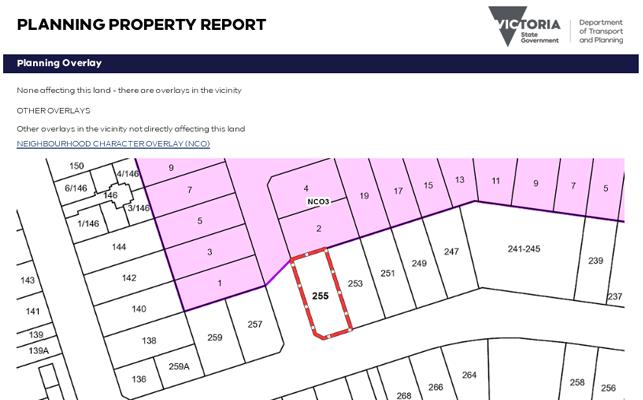
What a pre-purchase planning assessment covers
At RDBD we prepare pre-purchase planning reports for buyers who want to understand a property’s development potential before they commit. The report covers:
Zoning and applicable residential schedule. What the zone permits, what it restricts, and what the specific requirements are for any development you are considering.
Overlay identification and interpretation. Not just which overlays apply, but what each one means for your plans. A Heritage Overlay on a property you want to extend has very different implications than a Design and Development Overlay on a property where you want to build a granny flat.
Covenant and Section 173 review. Whether anything registered on the title or in the deposited plan would restrict your intended project, explained in plain terms rather than reproduced as legal text.
Preliminary development assessment. Based on the lot dimensions, zoning, and overlays, a realistic view of what is feasible: whether a granny flat is likely to be permissible, whether subdivision is possible, whether an extension or second storey would need a planning permit.
The report does not replace a planning permit application, and it cannot guarantee a council decision. What it does is give you the information you need to make a sensible purchase decision before you are committed, before the cooling-off period ends, before you have spent money on building design, and before you discover a covenant that prevents what you planned to build.
A Section 32 is where a vendor tells you what they are required to tell you. A pre-purchase planning assessment is where you find out what they did not have to.
Frequently Asked Questions
Can a Section 32 in Victoria be relied upon as confirmation that a property has no planning restrictions?
No, and this is one of the most important misunderstandings buyers bring to the process. The Section 32 vendor statement includes a planning certificate, known as a Form 10, which identifies the property's zone under the planning scheme. What it does not include is a list of the overlays that apply to the land. In Victoria's planning system, overlays sit on top of the zone and can significantly restrict or change what is permitted. A Heritage Overlay, a Design and Development Overlay, a Significant Landscape Overlay, a Flood Overlay: each of these can require a planning permit for work that would otherwise be permitted as of right, restrict building height, require specific materials, or limit site coverage beyond the base zone requirements. None of this appears in the Form 10. A buyer who reads the Section 32, notes the zone, and proceeds without an independent overlay check may be buying a property whose development potential is materially different from what the zone name suggests.
What is a Section 173 agreement in Victoria and how does it affect what you can build?
A Section 173 agreement is a formal agreement made under the Planning and Environment Act 1987 between a landowner and the relevant planning authority, typically the local council. It runs with the land and binds future owners, regardless of whether those owners were party to the original agreement or even aware of its terms when they purchased. Section 173 agreements are used for a wide range of purposes: restricting subdivision below a certain lot size, limiting the number of dwellings on a lot, preventing removal of vegetation, requiring car parking to be maintained, or imposing specific design requirements. Some are modest in their effect. Others effectively prevent development that the underlying zone would otherwise permit. If a Section 173 agreement appears in your Section 32, your conveyancer will confirm its existence. What they will not generally tell you is what it means for a granny flat, a dual occupancy, or a second storey addition you are planning. That interpretation requires someone who works in the planning system.
Are unregistered covenants on Melbourne property still legally enforceable?
Yes. The enforceability of a covenant does not depend on whether it is registered as an encumbrance on the Certificate of Title. Some older covenants, particularly those originating from mid-twentieth century residential subdivisions, exist in deposited plans or earlier title documents rather than as currently registered encumbrances. They do not appear in a standard title search in the way registered covenants do, which means a buyer relying solely on the Section 32 and a conveyancer's review may miss them entirely. Whether an unregistered covenant is practically enforceable depends on whether the original benefiting land still exists as a separate title and whether there are parties with standing to enforce it. This is a legal question that requires specialist advice in each case. The practical point for buyers is that a covenant that does not show up in the Section 32 can still restrict what you are allowed to build, and discovering it after you have engaged a building designer and committed to a design direction is an expensive way to find out.
What does a pre-purchase planning assessment cover that a Section 32 does not?
A pre-purchase planning assessment looks at a property's development potential from a planning and building design perspective, which is the dimension the Section 32 vendor statement is not designed to address. A thorough assessment will identify every overlay that applies to the land and explain what each one means for the specific project you have in mind. It will review the zoning requirements in detail, including site coverage limits, garden area minimums, setback requirements under ResCode, and any council-specific variations. It will examine registered and, where possible, unregistered covenants and Section 173 agreements, and explain what they restrict in plain terms. And it will provide a realistic preliminary view of what is feasible on the lot: whether a granny flat is likely to be permissible, whether a dual occupancy would require a planning permit and whether approval is realistic, whether a subdivision is possible under the current planning scheme. None of this replaces a formal planning permit application, and it cannot guarantee a council outcome. What it does is give you the information you need to decide whether to proceed with a purchase before you are financially committed.
How long is a Section 32 valid in Victoria, and what should buyers check if a property has been listed for a while?
A Section 32 vendor statement in Victoria is valid for three months from the date it is prepared. If the property has been on the market for longer than that, the vendor is required to update the statement. For buyers considering a property that has been listed for some time, it is worth checking two things: the date on the planning certificate included in the statement, and the date of the title search attached. An outdated title search may not reflect encumbrances registered after it was run, and a planning certificate that is several months old may predate changes to overlays or planning scheme amendments that affect the property. In practice, most Section 32 documents are refreshed when they expire, but a buyer who does not check the dates is relying on the vendor's diligence rather than their own. If either document is approaching or past the three-month mark, asking the vendor's agent to confirm the Section 32 is current before you proceed to contract is a reasonable step.
The information provided is for general information purposes only and does not constitute legal, financial, or professional advice. While care has been taken to ensure accuracy, the information may not be complete, current, or applicable to your specific situation. You should always do your own research and, where appropriate, seek advice from a qualified professional before making any decisions based on this information.
Recent Blog Posts

Tell us what you are planning
RD Building Design, a registered building designer, prepares pre-purchase planning assessments for buyers across Melbourne's western suburbs who want to understand what a property will permit before they commit. If you are purchasing with plans to build, extend, or develop, a site assessment before you sign is the right order of operations.